In this article
Check the cash need, card costs and ATM currency choice before withdrawing, then preserve a useful record if the machine fails.
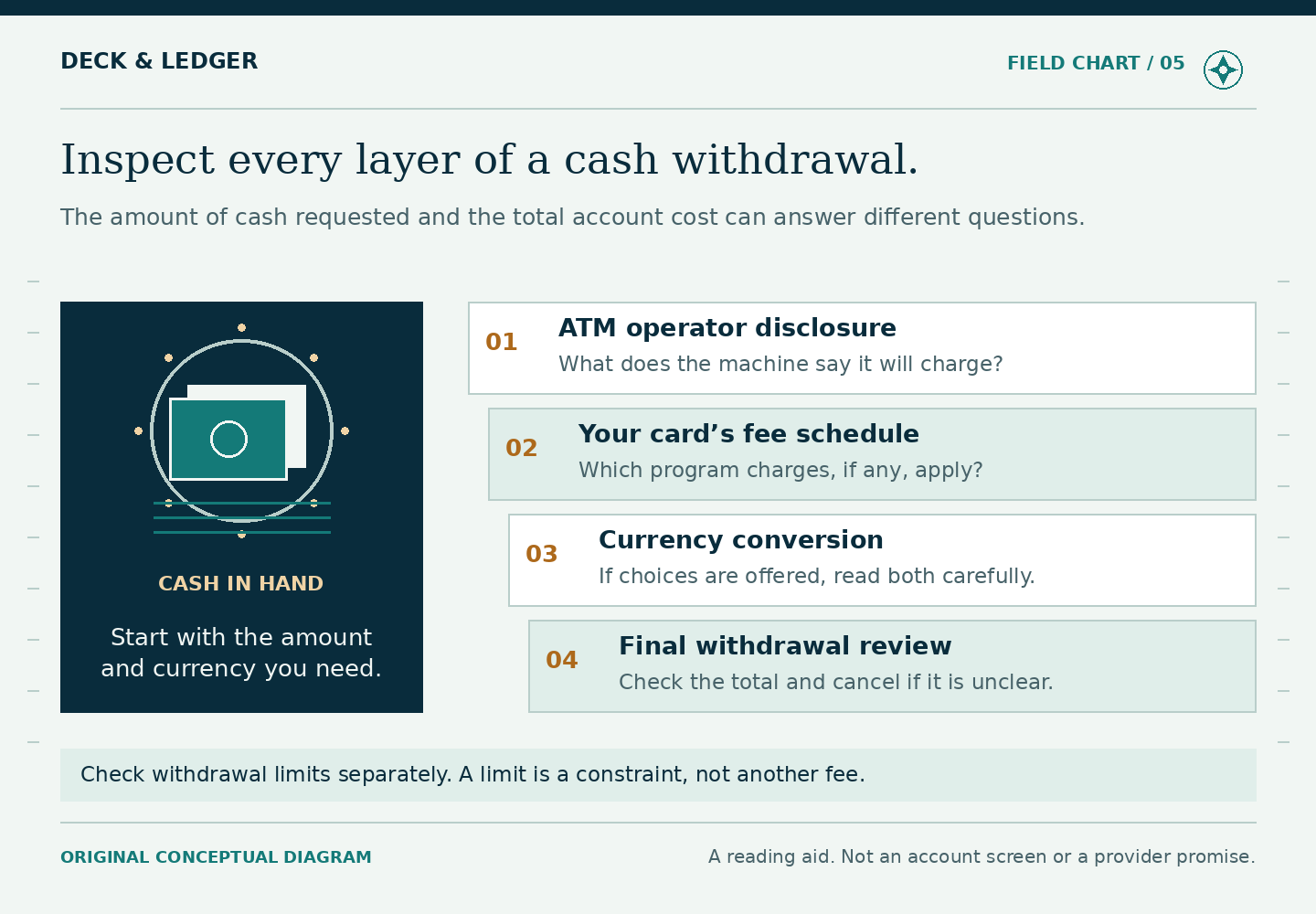
A short shore visit creates an awkward tradeoff: repeated withdrawals may add cost, while carrying more cash than you need adds a different risk. Start with the day’s practical requirements. Estimate transport, food and any cash-only purchases, keep the local currency visible, and decide what you can reasonably carry. There is no single withdrawal size that is best for every port or crew member.
Before you leave the vessel
Check the available account amount through the official channel while you have a reliable connection. Include any known commitments that must remain payable. Make sure you understand the card’s current status and that you know your PIN without writing it on the card. Save the verified support route separately from the physical card.
Review the fee schedule for your particular program. The CFPB’s general prepaid-fee guide distinguishes ATM withdrawal, balance inquiry and foreign-use charges. It is a checklist of possible categories, not evidence that your card charges each one or that a quoted fee applies internationally.
Separate the layers of cost
Think through four questions: does the card program charge for this withdrawal, does the ATM operator add a charge, is currency conversion needed, and are any other disclosed charges applicable? A machine described as free may only be making a claim about one layer. A payment-network logo tells you something about acceptance, not the total cost.
Brightwell’s crew FAQ says card purchases or withdrawals in a currency different from the card’s currency involve conversion and a conversion fee. Confirm your program’s actual schedule. Do not estimate the deduction simply by multiplying local cash by a rate from a travel website.
Read the currency-choice screen slowly
Visa explains that an ATM may offer dynamic currency conversion, showing the local amount, home-currency amount, exchange rate and markup. The choice should be yours. If required information is missing or you are pressured to accept conversion, Visa advises declining the conversion offer and reporting the issue to the issuer.
Declining an optional conversion offer is different from declining the cash withdrawal itself, although screen wording can be confusing. Read the buttons rather than selecting the largest or most brightly colored one. If you cannot understand the choice, cancel before completing the withdrawal and use another suitable route. Avoid rushing because someone is waiting behind you.
One larger withdrawal is not automatically better
Consider an invented example in which the only fixed cost is the equivalent of USD 4 per withdrawal. Two equivalent USD 40 withdrawals would cost USD 8 in that fixed charge, while one USD 80 withdrawal would cost USD 4. That arithmetic says nothing about the safety of carrying USD 80, the exchange rate or whether the extra cash will be useful.
A sensible decision balances the avoidable transaction cost against actual need and the consequences of loss. Do not withdraw additional money just to improve a fee percentage. Cash left over in a currency you will not use again can introduce another conversion decision later.
Use the machine deliberately
- Choose a location where you feel safe and can read the screen without distraction
- Look for anything visibly altered or suspicious before inserting the card
- Cover the keypad and keep the PIN private
- Read the amount, currency and disclosed charge before confirming
- Collect the card, cash and receipt, then put them away before leaving
If the machine offers a printed receipt, keep it privately until the entry is checked. An ATM balance inquiry may be a separately priced service, so do not use it repeatedly as a substitute for checking account history through the route your program provides.
If cash does not come out
Do not assume the absence of cash proves that no debit exists. Note the date, local time, location, machine identifier if visible, requested amount, currency and error message. Preserve the receipt. Check account activity and contact the official card-support channel promptly if a debit appears or the status is unclear.
Describe the problem precisely: no cash, partial cash, card retained or an unfamiliar charge. Those are different situations. Do not let a stranger handle the card or call a number from an unofficial sticker in response to a supposed malfunction. If the card is retained and cannot be recovered through a verified route, use the missing-card response plan.
Reconcile after returning
Compare cash received, receipt and account entry. Separate a displayed pending amount from the final posting and ask for an explanation if the figures remain unclear. The finished record should identify what you received and what it cost, without assuming that the same machine, fee or exchange rate will apply on your next visit.