In this article
Use total debit and expected receipt to compare transfer quotes fairly, including an example where the lower fee is not the cheaper outcome.
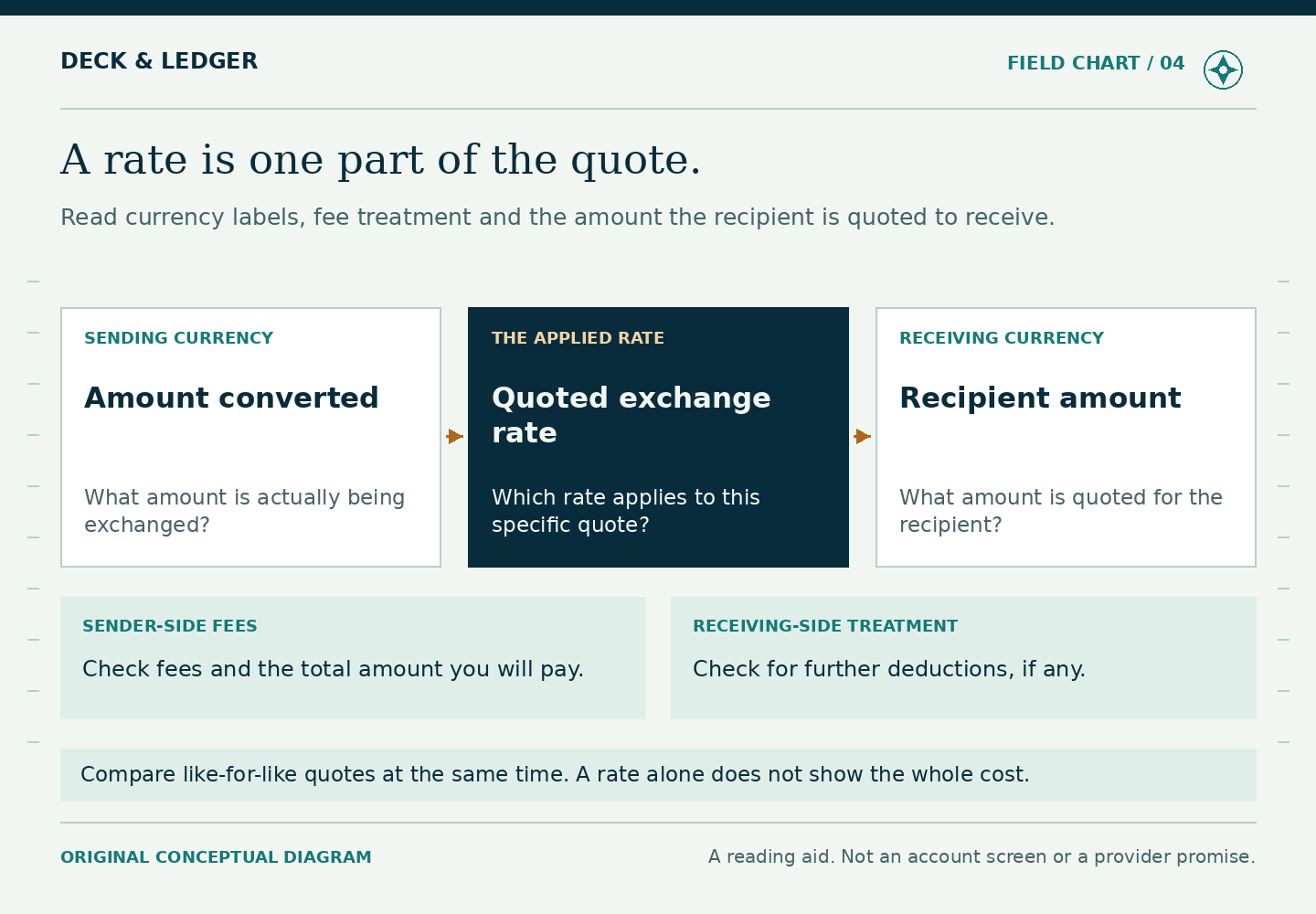
A large exchange-rate number can look attractive while a fee or deduction changes the final result. A small fee can look attractive while the rate produces less money at the destination. The simplest comparison starts with two figures: how much leaves your account, and how much the recipient is expected to receive. Keep both currencies visible throughout the calculation.
Choose the question you are answering
There are two useful comparisons. With a fixed sender budget, ask which quote delivers more of the same receiving currency. With a fixed recipient need, ask which quote requires the smaller total debit. Do not mix these approaches midway through the comparison. A larger send amount will usually deliver more, but that does not make its pricing better.
Also hold the receiving method constant where possible. A bank deposit and a cash pickup can have different practical value to the recipient. Price still matters, but comparing their costs without noting the different service can hide the reason one option is preferable.
Copy seven fields from the review screen
- The time you obtained the quote
- The source amount and currency
- The fee charged to you and whether it is included in the budget
- The total deducted from your account
- The quoted exchange rate and the direction in which it is expressed
- The expected recipient amount and currency
- Any warning about further deductions, taxes or delivery conditions
Brightwell’s transfer instructions direct users to review fees and the exchange rate before sending. They also identify potential additional charges for some routes. Use the current transaction details rather than prices shown in a screenshot, article or old receipt.
A fixed-budget example
Imagine two entirely fictional quotes for a total budget of USD 300. Quote A deducts a USD 3 fee from that budget, then converts USD 297 at 55 units of the receiving currency per dollar. The expected amount is 16,335 units. Quote B deducts a USD 1 fee, then converts USD 299 at 54 units per dollar. The expected amount is 16,146 units.
On those assumptions, Quote A delivers 189 more units despite its larger visible fee. The arithmetic is 297 multiplied by 55, compared with 299 multiplied by 54. These are invented figures, not current Brightwell prices or exchange rates. The example assumes no further deductions so that the effect of the two quoted components is clear.
Now suppose one quote warns that the receiving bank may deduct a charge whose amount is not supplied. Mark that outcome as uncertain. Do not subtract a guessed amount and call the result exact. Ask the bank or provider what can be established, or compare another available route with a clearer expected outcome.
A fixed-receipt example
Suppose the recipient needs 10,000 units. One route quotes a total debit of USD 190 and another quotes USD 193 for that same expected receipt. The first requires USD 3 less, assuming the same conditions and no unresolved deductions. Looking only at the exchange-rate headline is unnecessary once the complete comparable totals are available.
Keep timing in the decision. A cheaper quote that cannot meet an essential deadline may not solve the actual problem. Record the price difference separately from the service difference so you understand what you are choosing, rather than declaring one provider universally cheapest.
Do not confuse transfer FX with port purchases
An ATM or merchant can present a different kind of conversion choice. Visa’s DCC guidance describes optional conversion into the cardholder’s currency and the associated rate and markup disclosures. That is a separate decision from the exchange rate offered for a transfer home.
A card transaction, a remittance and a bank’s later conversion can therefore produce different figures without necessarily containing an error. Identify which service performed each conversion. Our port-day cash guide focuses on the ATM decision rather than combining it with a transfer quote.
Keep the comparison modest and repeatable
The CFPB’s remittance information is useful background on cost disclosures for covered U.S. transfers. It is not a worldwide guarantee of an exact recipient amount. Apply the disclosures and protections that actually govern your transaction.
Save the accepted quote with the receipt, then compare it with the final result. Refresh the comparison for a future payment because prices, destinations and available methods can change. Your finished worksheet should say what the quote meant on that occasion, without turning one successful transaction into a permanent claim about the best rate.