In this article
Compare the destination, total cost and timing of an available transfer route, then keep enough evidence to confirm delivery or investigate a problem.
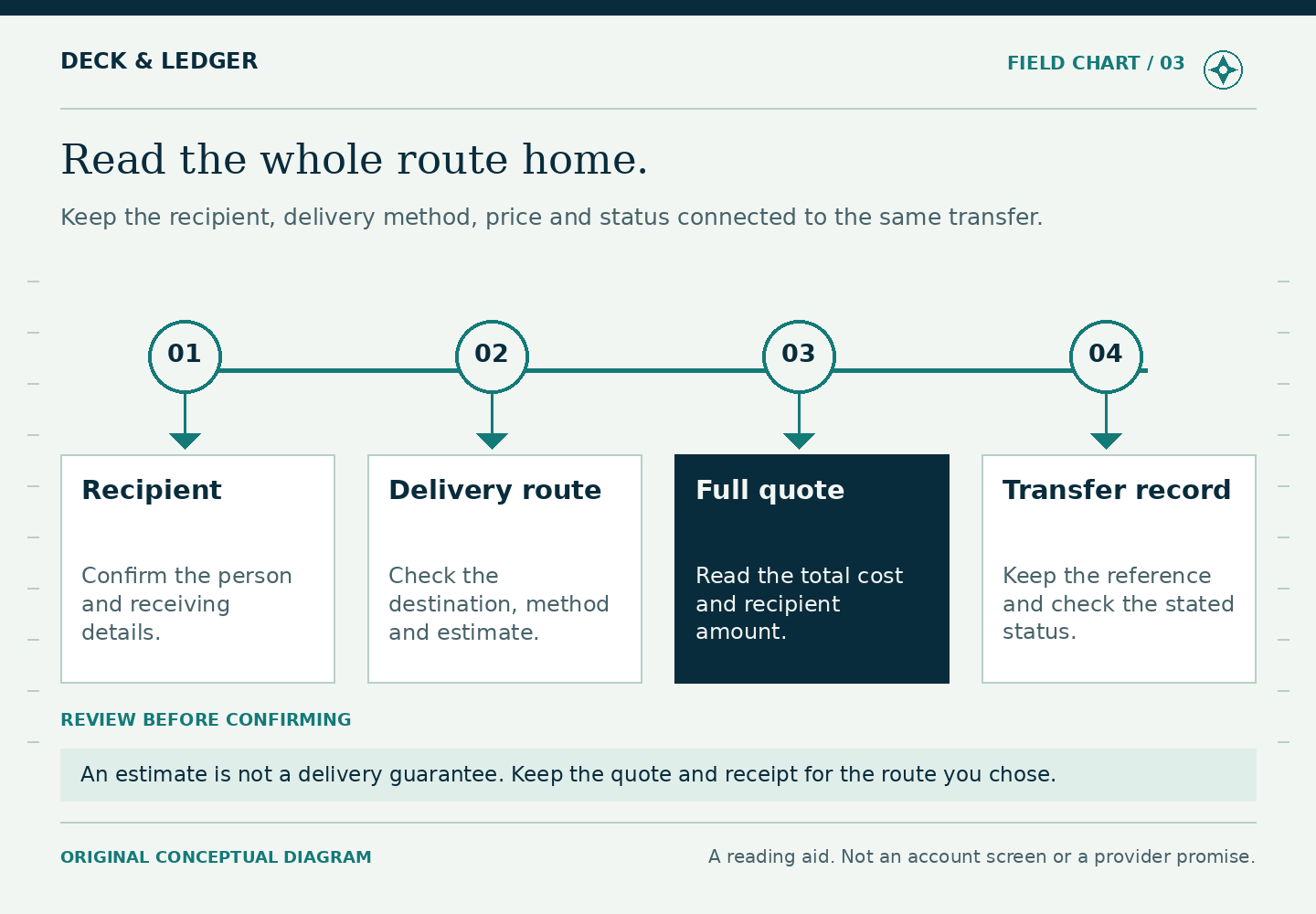
“Send money home” sounds like one task, but it contains several decisions. Who needs the money? In what currency? Where can that person actually receive it? When must it be usable? How much can leave your account while you retain enough for your own needs? Answering those questions before opening a transfer screen makes the eventual quote easier to judge.
This guide assumes you already participate in an employer-linked Navigator program. It does not promise that a particular route is available to every crew member. The objective is a completed, understandable payment record, not simply a successful tap on the send button.
1. Define the receiving need in ordinary language
Write a sentence such as: “My sister needs at least this amount in her bank account, in this currency, before this bill’s due date.” Or: “My parent needs cash from a location they can reach during its opening hours.” Leave account numbers out of this planning note. You are defining the outcome before collecting sensitive destination details.
A recipient who has a bank account may still face a practical problem using it. A cash collection point may be too far away. A mobile wallet may have a receiving restriction. Ask the recipient about access, not just preference. The convenient option for the sender is not necessarily convenient at the other end.
2. Identify routes actually available to you
Brightwell’s official transfer guide describes bank transfers, DirectPay allocations, cash pickup, debit-card delivery and selected mobile-wallet options, with program qualifications. DirectPay concerns recurring payday allocation; an OnDemand transfer is initiated when you choose. Availability, destination and the current quote must be checked in your account.
Do not treat this menu as a promise of worldwide coverage. Make a shortlist only from routes actually offered for your program and the intended destination. If the option a relative expects is absent, ask official support whether it is supported rather than searching for a separate registration page that appears to unlock it.
For recurring family expenses, also distinguish changing a future payroll allocation from making an additional transfer today. Both can be legitimate, but doing both by accident can move more money than you planned. Before initiating a one-off transfer, check whether an existing scheduled instruction already covers the same need.
3. Build a budget around total debit
Choose the most you can afford to have deducted, including the transfer’s disclosed charges. Leave room for port transport, required travel and any other commitments that must remain payable. A balance large enough to cover the send amount may still be insufficient for the full transaction if fees are charged separately.
In a fictional example, Luis has USD 650 available after reconciling known activity. He chooses to keep USD 140 for planned expenses and USD 60 as an uncommitted cushion. His transfer budget is therefore at most USD 450 in total debit. That is a planning decision in this example, not a recommended universal reserve.
If a quote says “send USD 450” plus a separate fee, it exceeds Luis’s chosen budget. He should compare a lower send amount or another available route, rather than subtracting the fee from the money he had deliberately retained. This is why the total taken from the account is the useful starting number.
4. Verify the beneficiary before comparing prices
Obtain destination details through a channel you already trust. If a family member suddenly supplies a different account or phone number, confirm the change separately. Do not rely on a forwarded screenshot merely because it contains the correct name. Use the receiving institution’s instructions where a payment route requires specific bank identifiers.
Check legal name, destination country, receiving currency and the identifier required by the chosen method. Have the recipient explain any unfamiliar difference rather than “correcting” it yourself. A shortened name used in a family conversation may not match an account record. Our beneficiary-detail guide provides a separate verification workflow.
5. Compare equivalent quotes
Write down the total you pay and the amount expected at the destination in the receiving currency. Note the fee, exchange rate, delivery method, availability estimate and any warning about additional deductions. Compare at roughly the same time and for the same budget. A quote for a different amount or currency is not a fair comparison.
The CFPB’s U.S. remittance explainer highlights advance cost information and receipts for covered transfers. That is useful reading, but coverage depends on the transaction and jurisdiction. Do not assume a legal protection applies worldwide because an educational article describes it.
Brightwell’s transfer instructions also warn that fees and delivery conditions vary and that intermediary or receiving-bank charges can matter. Its public timing descriptions have qualifications, including verification, banking hours and regulatory compliance. Read the actual transaction disclosure; a marketing example is not your delivery promise.
6. Put the deadline on the receiving side
A family bill due on Tuesday is not satisfied by a transfer initiated on Tuesday if the funds are usable later. Ask the recipient when the money must be available, then consider the quoted arrival information and practical collection needs. Record the destination’s calendar date and time zone if the obligation is time-sensitive.
Build an ordinary buffer when you can. If the deadline is already close, say so before choosing a route. Do not conceal uncertainty by telling the recipient a transfer is “instant” merely because a public page uses that word. A recipient may make a costly plan around a confident message that the actual transaction status does not support.
For cash pickup, access includes travel, identification and opening hours. For an account, it includes whether incoming funds are usable for the intended payment. These are planning questions for the recipient and provider, not reasons to send identity documents to an unrelated comparison site.
7. Make the final review a separate moment
Before submitting, stop scrolling and check the recipient, destination, currency, total debit and expected receipt. Re-read any newly displayed condition. If the quote has refreshed, compare the new figures with your budget rather than assuming the previous screen still applies. If the device has a poor connection, leave enough time to verify the outcome.
Then submit once and wait for the actual status. A frozen screen is not proof of failure. Before trying again, inspect the activity history and any confirmation message. If you cannot establish whether the first attempt exists, ask official support. Duplicate payments can turn a simple connectivity interruption into a much larger problem.
8. Share a useful receipt, not access credentials
Save the provider’s reference, the send date, the currencies and amounts, and the stated availability information. If the method requires a collection reference, share it privately with the intended recipient through a trusted channel. Do not confuse a payment reference with an account login code or send your password to let someone “check the transfer.”
Your family message can be brief: “I submitted the payment using this method. The receipt shows this amount and this expected availability date. Please confirm when it is available to use.” That wording distinguishes a submitted request from money already received. Keep the full receipt private if it includes unnecessary personal or financial details.
9. Investigate a delay without sending twice
Compare the current status with the receipt’s expectation. Ask the recipient to check the correct destination, then contact the provider with the existing reference. A failed pickup attempt may concern identification or location, while a missing bank credit may need a payment trace. Describe what actually happened instead of assuming the cause.
The CFPB’s money-transfer FAQ recommends prompt contact when there is an error and explains that cancellation depends on circumstances. If you need a correction or cancellation, ask immediately and check the receipt’s instructions. Do not assume that editing a saved beneficiary changes a payment already submitted.
If an urgent family need remains, distinguish solving that need from the status of the original transfer. Another payment could still leave you paying twice. Obtain a clear understanding of the first transaction before authorizing a replacement whenever possible, and avoid spending a promised refund before it actually arrives.
10. Close the record with what arrived
Ask the recipient to confirm the usable amount and currency. If the result differs from the receipt, keep both records and identify the unexplained amount without guessing which institution charged it. Update your private note so that next month’s comparison starts from evidence, not a memory that one route “felt cheaper.”
In Luis’s example, the process ends when he can account for the amount deducted, the money his family received and any remaining question. It does not end at submission. The result is a repeatable household routine: define the need, verify the destination, compare the complete quote, submit carefully and confirm delivery. Use the exchange-rate worksheet when two quotes are difficult to compare.